Am a huge follower of Charlie Munger, and I re-read his writings every so often ( http://www.tilsonfunds.com/motley_berkshire_charlie_speeches... ). What the two of them do is so much of a one-trick pony. They always seek massive rent capture via outright purchase of a corp with a very large moat. Then reduce the fiat risk by converting the cash into non-fiat income producing assets. This way they lock in wealth preservation regardless of what happens to the fiat. When I lived in New Mexico for a bunch of years, there was one constant - the incessant back and forth of the trains carrying coal containers from one end of the country to the other, and on the return trip carrying giant walmart containers shipped from China to the US ports, to their destinations in the rest of the mainland US. Everybody knew BNSF was the coronary artery of the US. One day I remarked to my wife - just you watch, Buffett is going to own BNSF. And then when it happened, she was like - how did you know ?! Its just so obvious. This SunPower thing was on the cards too. Prediction: He'll buy Vestas. Or Nordex. Just you watch...ofcourse you can't time these trades. Nobody knows the when, but the what is fairly well known at this point.
The way I understand what dxbydy has been writing, he or she is explaining how Warren Buffett often plays the opposite of a venture capitalist, risk-wise. He isn't a futurist, he picks off clear winners who are firmly entrenched in their markets.
While this is always a tough strategy -- because the easier they are to find, the more likely these companies are to become overrated -- it gets a little easier when you have a massive amount of capital. It's still tough to do consistently though.
The term "Rent Capture" calls out the distinction between entrepreneurs and landlords. The worth of land is obvious and so it takes other competitive advantages besides ingenuity to close a big deal. Pejoratively, as dxbydy mentioned, "rent capture" implies that the owners don't have to work very hard for their money.
"a very large moat" refers to the barriers to entry. Imagine you have 4 or five companies who built power plants 40 years ago. It was expensive for them at the time, but they made back their initial investment years ago and now the only thing they care about is market share. The size of their moat is proportional to how much it would cost for some new company to build their own power plant.
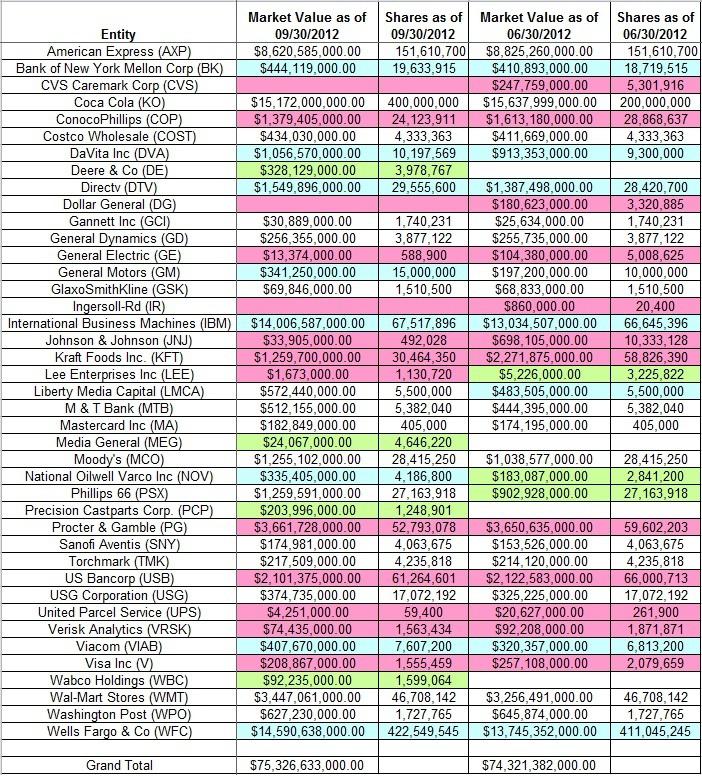
I think you do :) Probably you disagree with the characterization. I don't see why rent capture generally has such a negative connotation outside of finance circles. Its a perfectly legitimate strategy. And who has a larger moat than BNSF or Vestas or SunPower ? Even if you were a Zuckerberg you couldn't build these things in decades. Takes forever just to buy the land, spec out these things & get the specs approved by regulatory bodies. So if you could buy these concerns outright, you would. You would buy, whether it was making solar power or your underwear. ( He owns the largest underwear maker Fruit of the Loom ). Given the asymmetric info advantage he has, he's sold millions of puts expiring in 2019 & is sitting on top of billions in premium ( while simultaneously telling the American public that derivatives are instruments of the devil :) Got to park those assets someplace, otherwise fiat risks accumulate. His stock purchases for 2012 are quite ho-hum...utilities, banks, big media ( http://static.cdn-seekingalpha.com/uploads/2012/12/4/sauploa... )
> I don't see why rent capture generally has such a negative connotation outside of finance circles.
Well, it violates a lot of views of how the market "should" operate, on both the left and the right. On the right, some simplified versions of free-market views assume relatively perfect, efficient markets will normally develop absent government distortion, so they're suspicious of areas where rent is being extracted as probably due to some kind of intervention preventing a proper free market from operating. And on the left, many see rent-extraction as a paradigmatic example of the power of capital relative to labor (the ability of passive rent-extractors to in effect collect a "tax" from active economic activity).
people who do not own "rent producing assets" have a bias towards those who do, because a "rent producing asset" is something that gives the owner money, without the owner producing value, other than making the asset available. It is basically a facet of jealousy if you ask me...
Whether or not Tycho understands your terminology or not, I don't, and I bet a whole bunch of people don't. You use a lot of jargon (not in the negative sense of the word, but in the sense meaning highly specialized vocabulary). Could you actually answer tycho's request?
I hate to dumb down stuff that even wikipedia takes 2000+ words to summarize. But simplistically, Buffet is sitting on a mountain of cash. If interest rates go the wrong way, he is exposed to fiat risk. So his best bet is to trade that fiat risk for non-fiat income producing assets. He does that by outright purchases of very large companies whose competitive advantage is so huge they'd be impossible to defeat, and yet you can't get by without them. I mean, what are you going to do if you want 1000s of giant walmart containers sitting in LA moved to the midwest, and you don't like BNSF's pricing ? You are essentially fucked. So you play ball with BNSF. That's your moat right there. You can't build a railroad, not in today's climate. Its not like a gmail or an oracle in that you think those companies suck, so you switch to hushmail and mongodb. You basically have an out, so there's arguably no real moat in technology. But with large scale infrastructure projects, once you own a piece of them, you can just sit back & collect rent & everybody has no recourse other than to pay up.
"If you can't explain it to a six year old, you don't understand it well enough yourself." -- Einstein
In other words, express your command of a subject by how simple you make it appear, not by demonstrating how impressive and complicated the subject is.
I remind myself of this concept routinely, and struggle to reflect it in my writing and peer communications.
Thanks for the dumbed down explanation. I had a very clear idea of what you meant from your first post, however, the extra clarity gives me confidence that I understood it correctly.
Your first comment also dumbed down the exact same material - but in a different way. In the present day, among computer users and maybe people interested in finance, I have noticed the use of terser expressions, dense walls of text and shorter words to approximate the meaning of longer concepts (e.g. "moat", "sticky") to avoid recreating 2000+ word wikipedia articles.
Your first comment and the earlier commenter suggesting 'coca cola' having 'invented' santa claus (the user didn't mean the dictionary definition of invented), where two people are using language that has moved on from the dictionary definition, reminds me in some way of this essay by George Orwell.
I prefer the present-day contracting "meaning concentrating" style of abuse of language rather than the olden-day expanding "meaning dilution" style of abuse, however both make for uncertain reading!
I don't agree that Rent Capture is the correct terminology, because Buffett isn't using political or social engineering (so to speak), in order to capture the market.
He is simply finding companies with very high switching barriers that have occurred naturally in the market.
We usually associate "Rent Capture" with activities like limiting the amount of taxi licenses in a given city which helps incumbents but drives out competitors.
I don't see SunPower as being like the others. It's very, very hard to build a new set of railroad tracks so a railroad is pretty much of a monopoly. Anyone can (and does) build solar plants. It just takes capital and patience. Also railroads (and utilities) have immense lobbying capabilities and so are able to get very sweet, ever increasing rates (although for railroads they do of course have to compete with other modes of transport, but I'm sure with rising fuel prices they have huge advantages compared to over the road). SunPower however, as a developer, has to SELL to utilities and have NO pricing power nor real competitive advantage. They also typically sell on long term fixed price contracts in order to obtain financing and because that's typically all the utilities offer. I would be interested to know if Buffet has some kind of swap or other financial product that trades the long term fixed price stability of the investment (although low yielding) for something that provides more yield but is more variable.
With respect to "rent capture", they're referring to economic rent. Basically, a situation where competition cannot affect the price of a good. Great if you receive payment for that good, less so if you're paying it.
Pretty sure "moat" is a term popularized by Warren Buffet himself to describe a company with some kind of inherent advantage over it's competitors. As in, when a company with a moat succeeds, his competitors have a hard time entering that market and replicating that success because of the moat.
A moat protects your marketshare. A very large moat then would be, I guess (I'm not an investor or anything), a company with a large competitive advantage and a market share that would be very difficult to steal.
A good example of a moat - and a company that Buffett has invested in - Coca Cola.
They've invested enormous sums in marketing sugary syrup, a product with a sizable margin. Others produce sugary, fizzy water too, but there's only one Coca Cola and it's impossible to overcome in the marketplace.
Rent capture: landlords collect rent on the house they own the right to. Similarly, lets say the government or any contracts grants some body special privileges, the money they earn on those privileges in excess of what they would have otherwise is a rent capture. EG: lawyers get more money because only they are allowed to do certain legal work. The rate they collect in excess of what someone unlicensed but qualified would charge is a rent capture (rent seeking activity?[0]).
fiat (govt currency) risk is if you are keeping 100 million in a bank account and Bernanke keeps running the printer, then one day you will wake up and it will buy approx three eggs.
So best to ensure you have physical wealth assets on hand that can't be conjured out of thin air.
What about FDIC bank guarantees? Well sure the 100 million is guaranteed. It's purchasing power is not.
it sucks that purchasing power is lost for people without lots of money. It seems inherently an unfair system - if you stop producing value, your existing store of value diminishes thru no fault of your own.
the trick is to realise that currency was not designed to be a store of value so don't use it as such.
To paraphrase Silvio Gesell, an economist in favor of symbolic currency almost a century ago, "All the physical assets of the world are at the disposal of those who wish to save, so why should they make their savings in the form of money? Money was not made to be saved!"
ie: you don't need to buy whole companies outright to avoid saving in currency.
I am presuming that the moat being in this case the high locked in prices paid for solar power at the peak of the 'we must create renewable energy' frenzy.
It is unlikely that new solar plants would be able to get the same types of long-term power supply contracts that an existing plant might have got 5 years ago. At the residential level, most solar FIT have been slashed as government programs ran out of money and public enthusiasm waned as the non-participants bills went up.
But yes, a solar power plant is a utility, and if it has locked in contracts (I admit I have no idea if it does) it would be a good buy, if nothing else but for the inflation hedging as power always follows inflation but many other revenue streams do not.
They might also enjoy from tax breaks (future or present). I'm not clear on how, but with Buffetts talent to bend tax laws, you can be sure that is taken into account.
I always wondered if it would be possible to create a fund or something that invested/bought up bankrupt but useful infrastructure projects. The two that spring to mind our Iridium Satellite Phone and the UK-France Channel Tunnel.
Both excellent ideas that were unlikely to earn back the cost to produce them, but if bought after bankruptcy and sunk costs have been written off they could be profitable.