I've seriously contemplated getting one of these. Street legal, fuel efficient, simple, but when I started researching them I started to see a pattern. It's hard to find anyone in rural areas willing to work on them and not all mini trucks are equal. Some are not shipped correctly and have frame rust issues. There are YouTuber's that cover some of the models and the gotchas and things to inspect. I would never buy one without inspecting it locally. I've seen a couple of them in town and the owners somehow manage to keep them running.
I am leaning more towards a street legal side-by-side as there are a few dealers here and they have people to perform more advanced repairs. Downside is they cost more especially if I want a fully enclosed cab with windshield and heater, something that is a must during the winter here. Upside is I can take it into the mountains and also use it to run into town for groceries.
An upside to either of these options is that these are the remaining vehicles that do not as of yet have any of the telemetry, dashboard infotainment systems, pay-as-you-go for subscriptions for standard features, etc...
The trucks have all just gone through auction and have inspection reports. Mine I bought for $2k was grade 3.5 and what I’d consider pristine for a 25 year old truck. The Japanese are pretty trustworthy people to do business with, and they build great vehicles.
One thing the author left out was the fascination I had with the whole process. Watching auctions, assignment to a ship, tracking it through the ocean and storms and watching on video as it passed through the Panama Canal. Then the customs and importation paperwork with CBP, going to the port, the driving 200 miles home in my new “truck” that had road manners more akin to my golf cart than anything actually on the road around me. I-95 was terrifying— I barely got off the on-ramp before looking for the next off-ramp to find backroads for the rest of the journey.
These are still made and sold brand new starting at around $6000. The interest in 90's ones is due to the 25-year rule on hassle-free importing into the US.
I seriously miss compact trucks, like the Mazda B-series, Ford Courier, Ford Ranger (before it became a mid-size in 2019).
These kinds of trucks might more to your liking. Sure they aren't as small and cute as the imports, but your local auto store can still get you parts for them.
They are fun to drive, fairly fuel efficient, and are capable of hauling material from the home center. I learned to drive stick, and how to pop the clutch when you have a dead battery, in a Ford Courier on the high plains of west Texas.
I still drive a manual 2002 Toyota Tacoma and you'll have to claw it out of my dead hands for this exact reason. I really love the utility of a pick-up truck, but I absolutely despise the size of any of them in the US in the past couple of decades.
I wish they still made mid-sized pick-ups that were actually mid-sized.
A Tacoma is nearly the size of Tundra was twenty years ago, and a Tundra today is like the size of a damn schoolbus.
I drive past a 1970s Ford truck daily and nothing has changed with sizes in the same vehicle category. Newer cars are just more bulbous and thicker. Full-size pickups have been just short of 80" wide since regulations in the 1960s on clearance lights. What _did_ change is the compact truck category vanished for a while (and those compacts were then re-designed as mid-sized). The category is making a comeback now with unibody trucklets like the Ford Maverick and Hyundai Santa Cruz.
But no, a new Tacoma isn't even close to the size of an old Tundra (212 vs 230 inches length, 75 vs 79 inch width). Also a new Tundra is right there with the size of an old Tundra (233 vs 230 inches length for double cab, same width)
- emissions and efficiency regulations that vary with the footprint of the vehicle. Vehicles with larger footprint (= width x length) are allowed to have lower fuel economy numbers, which perversely means that one solution to a truck having poor fuel economy is to make it… bigger.
Another driver is everyone getting pickup trucks and the resulting market distortion. Farmer that needs to haul equipment? You need a pickup truck. Family of four that needs to do the school run? For some reason you’ll also be getting a pickup truck. And there are a lot more of the latter to market to.
There's a lot of room to talk yourself into a pickup. They aren't cheap. If you can afford one, you can also probably afford a boat or a trailer. If either is of more than diminutive size (even theoretically, as a planned future purchase), that basically narrows you down to a pickup or equivalent size SUV. If you also want to carry home improvement goods (concrete blocks, plywood, drywall, or anything longer than 8'), it's way easier to get those in and out of a pickup.
I don't think most people use their trucks this way most days, but it's easy to convince yourself you will.
I’d also add that they became a lifestyle accessory. Once SUVs started getting identified with soccer moms, the size and macho styling of pickups started going up along with the price. That makes a lot of sense financially for the manufacturer since a business user is going to be a lot more price sensitive, especially for stuff which isn’t durable, and there are a ton of people who don’t really need one but like the image so moving in that direction can grow your market significantly as long as you don’t drive away your original audience.
If you want to actually carry passengers in your truck, you want 4 doors and a full back seat. The new Tacomas are great trucks, because it's practical to carry cargo or people in them. Old single cab Rangers, Luvs, Tacomas, etc, were fine, but not as broad market.
If you need to carry passengers, a truck probably isn't the right choice. Four doors and a bed make for an oversized and inefficient vehicle for hauling either people or cargo alone. You say "broad market", I say "ill suited for most tasks."
> If you need to carry passengers, a truck probably isn't the right choice. Four doors and a bed make for an oversized and inefficient vehicle for hauling either people or cargo alone. You say "broad market", I say "ill suited for most tasks."
It's a fine choice, as long as the truck has 4 doors. And the super cabs don't really affect gas mileage much at all.
When I was growing up, my dad had one of those tiny Rangers. There were 3 of us kids. My dad was a part-time plumber and also built our house when we were younger. We'd make regular trips to Lowe's or whatever with him when my mom was working. There weren't even 4 separate seat belts. It wasn't really safe, and it was a tight squeeze that was only possible because we were quite young. Anyways, many reasons why you sometimes need to do both.
Yep. It's a big reason I stuck with a Fit (can still cram in a decent amount of stuff) instead of a small pickup.
Aside from the fact that there don't seem to be small pickups anymore, the closest ones I've found all seem to have 4 doors and a really short bed. I can count on one hand the number of times I've had more than one passenger in my Fit, but I frequently need to pick up large items at the local home center or haul things to the dump (old home renovation).
But since most smaller trucks seem like large cars with stubby beds, I settle for having my 4x8 plywood sheets ripped at the store or scoring/folding drywall sheets so I can slide them in from the hatch to the passenger seat.
Nothing has happened -- new trucks are within the dimensions of old trucks +-5% for similar configurations. This is very easy to validate with a quick search. The real question is how this myth got started.
It's so bizarre to me as an Australian that these are considered "compact". Here they are the standard utility vehicle for every tradesman (although the Toyota Hilux is perhaps most popular). Coming from my hatchback I find these long and awkward to park / merge.
Sadly Dodge Rams and other stupid big US cars are starting to rear their ugly faces, although they look hilariously out of place on our roads. A popular term for them is "emotional support vehicle"
I'm utterly baffled why Toyotas like the 79 Series LandCruiser hasn't taken over the United States yet
It is the most American vehicle ever made
Next to no electronics, far stronger than a Hilux, all standard dirt cheap parts that are all entirely serviceable in the middle of no where and most importantly for Americans: a massive V8 diesel engine
Out bush I see quite a few 6 wheeler modified ones with double 220L (63 gallon) fuel tanks
US Regulatory capture shooting themselves in the foot I guess
A couple reasons might be the chicken tax (25% tariff on all imported trucks) and if it's "too small" it might be in the category of light trucks where the EPA imposes very strict fuel economy standards.
I blame regulatory capture for both of these things. Gotta protect American big truck manufacturers from competition from smaller, lighter, possibly cheaper vehicles.
The MY2022 Maverick is what the new Ranger should have been. And the Hyundai Santa Cruz also was introduced in MY2022. Finally some steps in the right direction, at least.
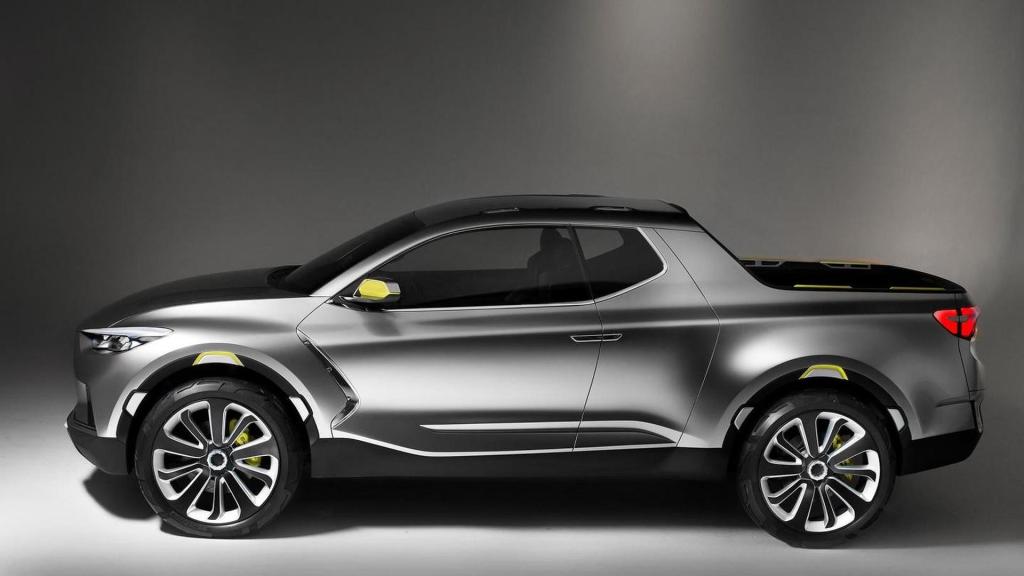
I wish they would roll out a two (or two and a half) door version of the Santa Cruz like the original prototype [0].
My 2001 Ford Ranger hit this sweet spot beautifully but it was a DOHC and when the timing chain came apart it wasn't worth doing an engine swap. I can't find a replacement currently but am holding out hope for the Toyota Tacoma electric in a year or two.
Checked em out, but again...more seats and less bed is not what I need. I just want a car-like light truck for me to drive around the city alone or with a single passenger during the week and pick up sheets of plywood or drywall on the weekends. Don't want a big truck, don't need to carry a family of four.
But Santa Cruz is at least a step in the right direction.
The brazilian Ford Courier model was an amazing pickup. Its 1.6 engine was a beast for the weight (~1000kg if I remember correctly, you’d lose traction on launch very easily).
I’ts kinda crazy that cars like that are not even made anymore. You can barely load a couple boxes into most of the currently popular extended-cabin abominations.
I used to use an old Ford Ranger on a farm as a teen and it was a great truck. It was tough in its own way, easy to fix, and took alot of abuse. I rolled it once (not in it fortunately), and got it stuck in a stream. We dragged it out was a tractor, rolled it upright, waited for the carburetor to drain or something and got it back on the road.
I still long in my heart for a pickup that is as small as possible while having an 8 ft bed, but honestly once you also need to take children with you wherever you go, the compromise of a shorter bed with a good sized back seat (to accommodate car seats) really begins to make a lot of sense.
I ended up just attaching a trailer hitch to my Chevy Volt and buying a lightweight 8ft trailer. As long as I just need to move big and not heavy, it's perfectly adequate, and the mileage when I'm not hauling is a lot better.
And it cost me about $2k while keeping me out of the insane used truck market.
the people that depend on these vehicles are particularly tuned in to how to keep them alive...
Years ago, when my wife and I lived in a 'rural adjacent' community we had a ~20 year old manual transmission european sedan sitting in our driveway for about a year, tires slowly deflating, until one couple stopped by to enquire about it. My wife told them that if you can get it running you can have it, the husband came back a few days later to sign the paperwork, and after popping the hood and turning a few knobs was able to get it started and drove it away :)
Very happy that the vehicle had an extended life with someone that could put it to use.
They probably share a lot of the same drivetrain/engine/etc. parts from vehicles of the same era. If you are mechanically inclined and have the right tools, you might be able to do some of the work yourself. Most auto mechanics familiar with older Japanese branded vehicles should be able to work on them like they would on a regular US import.
The biggest issue I have is that they are right-hand drive. I'd be hesitant driving a mini-truck on streets and highways, even if it's licensed. This would be a non-issue if the intent is to leave it on private property, unlicensed.
I wish mini-trucks had a bigger demand here. I'd like a pickup, but I don't need the monster trucks that are on the market these days. Just something to move furniture, appliances, and junk around town.
The problem with the Maverick (as others have mentioned) is that they squander valuable bed space by adding a cab to the design.
To me, a pickup truck is a pretty utilitarian thing. I don't need a cab. I have other vehicles if I need to take passengers.
I remember pricing out a pickup a few years ago, and it was hard to find one that wasn't already configured with a cab. I guess the market demand is larger for people who have kids but still want a pickup for whatever reason.
>I guess the market demand is larger for people who have kids but still want a pickup for whatever reason.
Or people who buy trucks for their business. It's much easier to put a whole crew into one-two vehicles instead of driving each man in his own truck especially if you do residential work, where worksites might not have ample parking or any parking for that matter.
Perhaps consider a visit to New Zealand and buying one there if you can’t import one from Japan (keyword “direct import”), although your total costs would be high. We are friendly buggers over here, so you are not likely to get ripped off unless you are a numpty. Buy an unregistered spare one for parts - used farm ones without plates get sold much cheaper.
https://www.trademe.co.nz/a/motors/cars/suzuki/carry/search — all used imports from Japan. Note prices are in NZD, reduce prices by 1/3 to get to USD. You can get GST (sales tax) refunded on exports but it might not be much money because second hand goods are zero-rated?
I really wanted a 1.3 litre 4WD Suzuki Carry a few years ago, but they really hold their value so they were not cheap enough for me. USD8000 for a 20 year old ute! They are in high demand in NZ.
I personally would avoid the Subaru mini-truck: I think mechanical issues and access to parts are problems. I also looked at the equivalent Hyundai mini-truck, but the Suzuki is probably the best bet.
Japan has regulations that make old vehicles expensive to keep, so they export them before they get really old. New Zealand buys a lot of second hand car stock from Japan. If you need something 25 years old, then New Zealand might have more stock.
We don’t salt our roads. Anything that has spent all its life in dry areas like the Canterbury Plains would be best - don’t buy if it has been long periods in wet climates. Avoid anything that has been on the coast - avoid sea-spray rust damage (don’t buy from my local area, New Brighton).
Yeah, but this thread seems to mainly be talking about left-hand drive imports.
If someone does their homework, they could bring over a big American Ute to NZ (buy cheap in US, sell for heaps in NZ). Need to be extremely careful about NZ regulations though - complicated and relatively costly/risky. Ideally find someone in NZ that has done it for the model you would import into NZ.
>It's hard to find anyone in rural areas willing to work on them and not all mini trucks are equal.
Living in a rural area, I first saw these popping up at least a decade ago. The typical farmer / rancher has to be mechanically skilled and one of the benefits of these vehicles is that they are relatively simple mechanically speaking, IE: assuming availability of parts you could do the work yourself.
I’ve also found that many rural mechanics (try the tractor/large truck guys if the car mechanic is skittish) are perfectly willing to work on them for time+materials; they want to know that you know it may take more time and cost more. Once past that they’re quite capable.
So if you can source the parts for them, and be willing to have it take some time; you’ll find help.
I’d recommend looking for a reputable dealer who does a proper shipment and inspection. Here in Seattle we have https://sodo-moto.com who works with fvej.com to bring vehicles over and ensure the quality.
Too bad you aren't inclined to work on them yourself. To me a key truck is a "hobby car" and I have no compunctions about learning to wrench on one. (YouTube certainly has plenty of how-to videos on it.)
isn't it getting hard to get any kind of car worked on in rural areas?
It is. I can do some mechanical work but I have no idea what special tools and tricks are required knowledge with these trucks. At least with side-by-sides there are a myriad of dealers and mechanics near me as so many people use them around their ranches, to go into town and to go into the mountains. There is probably some little shop that would say they could work on the mini-trucks but my experience with the small businesses here as that most of them fake it until they make it, but they never make it. So I would be taking a bit of a gamble. If I found one that was cheap enough it might be worth the gamble as I could just write off the loss if it has some obscure problem. That is why I am still on the fence.


I am leaning more towards a street legal side-by-side as there are a few dealers here and they have people to perform more advanced repairs. Downside is they cost more especially if I want a fully enclosed cab with windshield and heater, something that is a must during the winter here. Upside is I can take it into the mountains and also use it to run into town for groceries.
An upside to either of these options is that these are the remaining vehicles that do not as of yet have any of the telemetry, dashboard infotainment systems, pay-as-you-go for subscriptions for standard features, etc...